Open now · 24 hours a day, 7 days a week 90-minute response target Call (904) 682-0008
FlamingoDrainDrain & Sewer
(904) 682-0008

Common clogs, honestly explained

Every drain in your home fails in its own particular way, for its own particular reason. Here is what actually causes each one, what the early warning signs look like, and the one or two things that turn a routine service call into a much worse afternoon.

Call (904) 682-0008

Read this first

One fixture or several? That is the only question that matters.

Before you worry about which drain it is, find out how many drains are involved. Run water in a second fixture on a different side of the house and watch. If that one is fine, you have a branch line problem, which is a straightforward service call. If it is also slow, or if it burps while the first one runs, the shared main line downstream is restricted, and no amount of work at any single drain will help.

People spend a lot of money on the wrong end of this. Three bottles of drain opener and a rented snake will not touch a blocked main.

The 60-second test

  1. 1.Flush a toilet on a different side of the house from the problem drain.
  2. 2.While it refills, run the tub or shower on that side for thirty seconds.
  3. 3.Watch the lowest drain in the house, usually a tub, shower or floor drain.

Everything behaves normally: branch line problem, one fixture, routine.
Anything gurgles, rises or backs up: main line problem. Stop using water and call us.

Clogged kitchen sink

Kitchen sinks do not clog on objects. They clog on grease. Every time warm fat, oil or cooking liquid goes down the drain it travels a few feet, cools, and sticks to the pipe wall. Over years that becomes a hard, uneven layer that keeps narrowing the pipe until the day it finally closes. Coffee grounds, rice, pasta and eggshells make it worse because grease gives them something to hold onto.

This is why a kitchen sink almost never fails suddenly. It gets a little slower every month, then one evening it stops. If yours is draining slowly right now, that is the cheapest moment it will ever be to deal with.
Warning signs
Water pools around the strainer before it clears. A gurgle from the other basin. A sour smell that comes back a day after you clean it. The dishwasher leaving standing water in the tub.
What we do
We cable the branch line to restore flow, then recommend hydro jetting if the cutter head comes back coated. Jetting strips the grease off the wall instead of boring a hole through it, which is the difference between fixing it and postponing it.
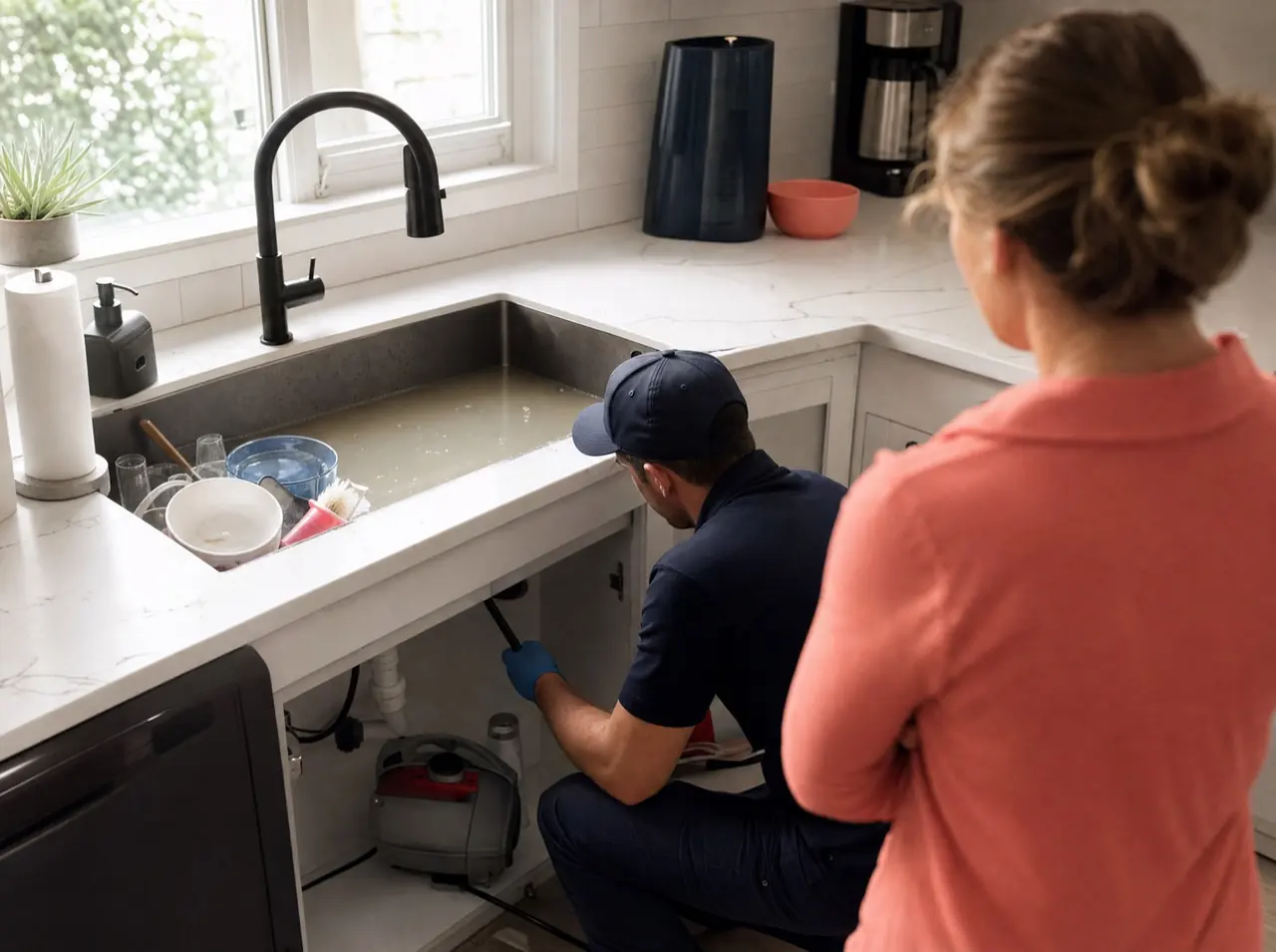
A kitchen sink full of standing water from a blocked drain

Please do not

  • Pour chemical opener into a basin full of standing water. It will not reach the blockage and we then have to work in it.
  • Run the disposal over and over. It packs the debris tighter against the blockage.
  • Chase grease with hot water and dish soap. It re-solidifies twenty feet further along where it is harder to reach.
Garbage disposal backing up

When a disposal hums, jams, or fills the sink with dirty water, people replace the unit. Most of the time the unit is fine. The disposal grinds waste into a slurry and sends it into the same greasy horizontal line described above, and when that line cannot take it, everything comes straight back up into the basin.

A genuinely failed disposal sounds different. If it hums without turning, something is jammed in the plate. If it does nothing at all, check the small reset button underneath before you assume the worst.

Warning signs
Dirty water rising in the other basin when you run it. The dishwasher backing up when the disposal runs. A grinding noise that changed recently.
What we do
We clear the line the disposal discharges into and confirm the unit drains under full load, not just a trickle. If the disposal itself has failed we will tell you plainly rather than clearing a line that was never the problem.

Keeps it out of trouble

  • Run cold water, not hot, while grinding. Cold keeps fats solid so they get chopped and carried instead of melting onto the pipe.
  • Keep running water for twenty seconds after the grinding stops, so the slurry actually leaves the horizontal run.
  • Keep fibrous waste out: celery, onion skins, corn husks and coffee grounds cause more disposal calls than anything else.

Please do not

Put your hand into a disposal, even with the switch off. If something is jammed, cut the power at the breaker and use the hex key slot underneath, or call us.

Dishwasher not draining

A dishwasher that leaves an inch of gray water in the bottom is usually reporting a kitchen drain problem rather than an appliance problem. The dishwasher discharges into the sink drain or the disposal, so when that line is restricted the machine cannot push its water out and it stays in the tub.

The other frequent culprit is the air gap or the high loop in the drain hose, which exists to stop sink water siphoning back into the machine. When the air gap clogs, water backs up and often spurts out of the little chrome cap on the countertop.

Warning signs
Standing water after every cycle. Water bubbling out of the air gap on the counter. Dirty sink water appearing in the dishwasher when you run the disposal.
What we do
We check the air gap and the drain connection first, then clear the kitchen branch line. Nine times out of ten the machine works perfectly once the line it drains into is open.

Before you call anyone

Fill the sink, then let it drain and watch the dishwasher. If dirty sink water appears in the bottom of the machine, this is a drain problem and an appliance repair visit will be a wasted trip.

Clogged bathroom sink

Bathroom sinks clog close to the surface, which is good news. Hair catches on the pop-up stopper and on the pivot rod behind it, then soap, toothpaste and skin oil bind it into a dense mat that sits right in the trap. It is unpleasant to look at and it is rarely serious.

If you pull the stopper straight up and find the problem hanging off it, you have just done our job for us and we would rather you kept your money. If it is still slow with the stopper out, the mat has moved past the trap.

Warning signs
Water taking longer to clear after brushing your teeth. A ring of scum around the drain. A faint smell when the room is closed up.
What we do
We clear the trap and branch, clean the stopper assembly, and reseat the pivot rod so the stopper stops catching hair on the way past. We reassemble with fresh washers so nothing weeps under the cabinet afterward.

Please do not

  • Use chemical opener on a hair clog. It does not dissolve hair, and it is hard on older chrome and plastic traps.
  • Over-tighten the slip nuts if you take the trap apart. Plastic ones crack easily and then you have two problems.

Clogged toilet

A toilet blocks in one of two places, and telling them apart is the whole game. If the obstruction is in the toilet's own trapway, it is a fixture problem and an auger sorts it out. If the obstruction is in the line behind it, the toilet is simply where you happened to notice a bigger problem.

What clogs them has changed. Wipes labeled flushable do not break down the way paper does, and they are now the single most common thing we pull out of residential toilet lines. Add the cotton products, dental floss and paper towel that follow them and you get a mass that catches on every rough spot in the pipe.

Warning signs
The bowl fills higher than usual before it clears. You have to hold the handle down. The water level drops on its own between uses. It bubbles when the washing machine drains.
What we do
We auger the fixture first because it is quick and non-invasive. If the auger comes back clean, we move to the cleanout and cable the main line, then camera it so you know what is down there.
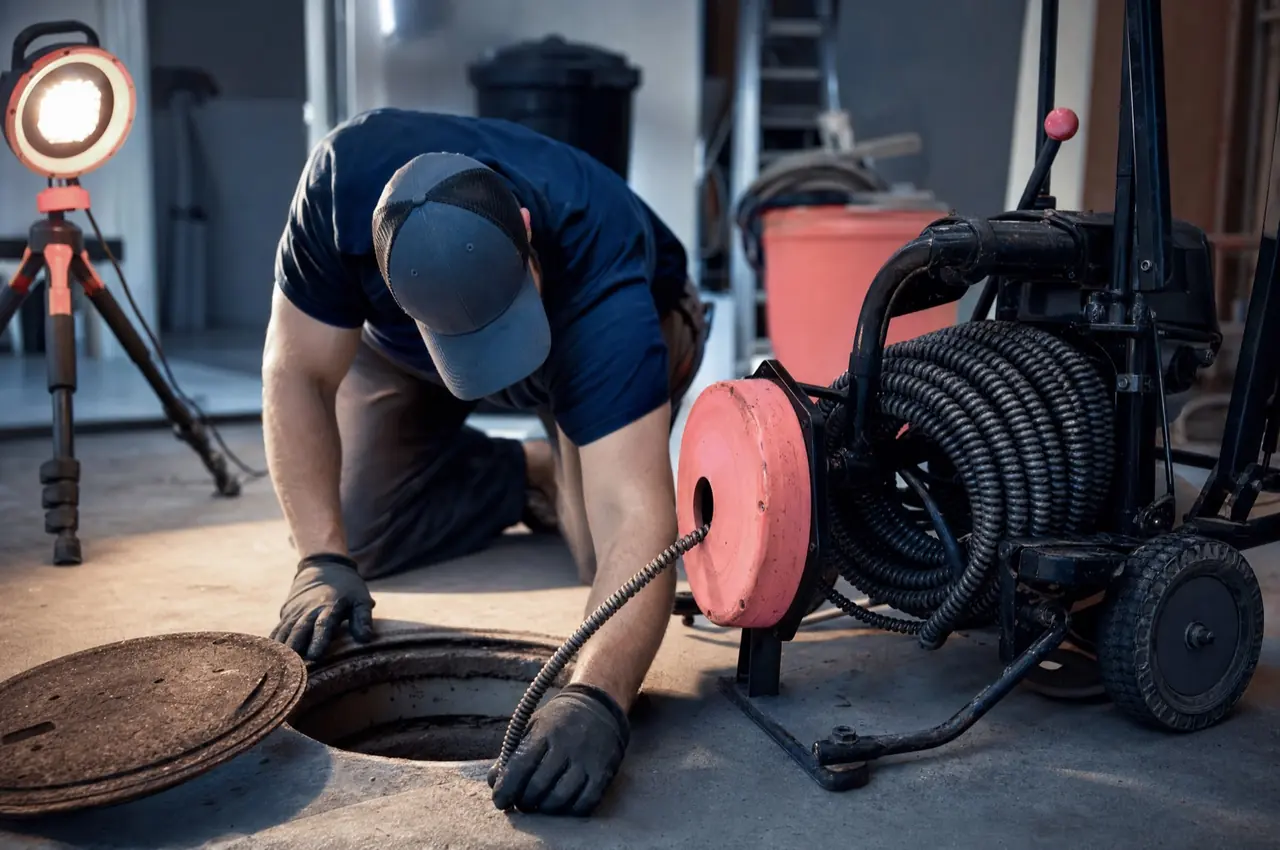
A heavy-duty sectional drain machine set up at a main sewer cleanout

If it is full right now

  1. 1.Take the tank lid off and push the flapper down so the tank stops feeding the bowl.
  2. 2.Turn the supply valve behind the toilet clockwise until it stops.
  3. 3.Do not flush again to test it. That is what causes almost every overflow we get called to.

Clogged shower or bathtub

Shower and tub drains fill with a rope of hair bound together by soap scum and body oil. It forms just below the strainer and grows downward into the trap. Standing ankle deep by the end of a shower is the classic first symptom, and it usually appears months before the drain actually stops.

Because tubs and showers sit low, they are also the first place a main line backup surfaces. If the water in your tub is dirty and you did not put it there, that is not a tub clog, that is sewage finding the lowest exit it can.

Warning signs
Water around your ankles by the end of a shower. A gurgle from the drain when you flush the toilet. Dirty water rising in the tub on its own.
What we do
We pull the strainer, clear the trap, and cable the branch back to the stack so the drain runs at full speed instead of just moving the mass a bit further along.
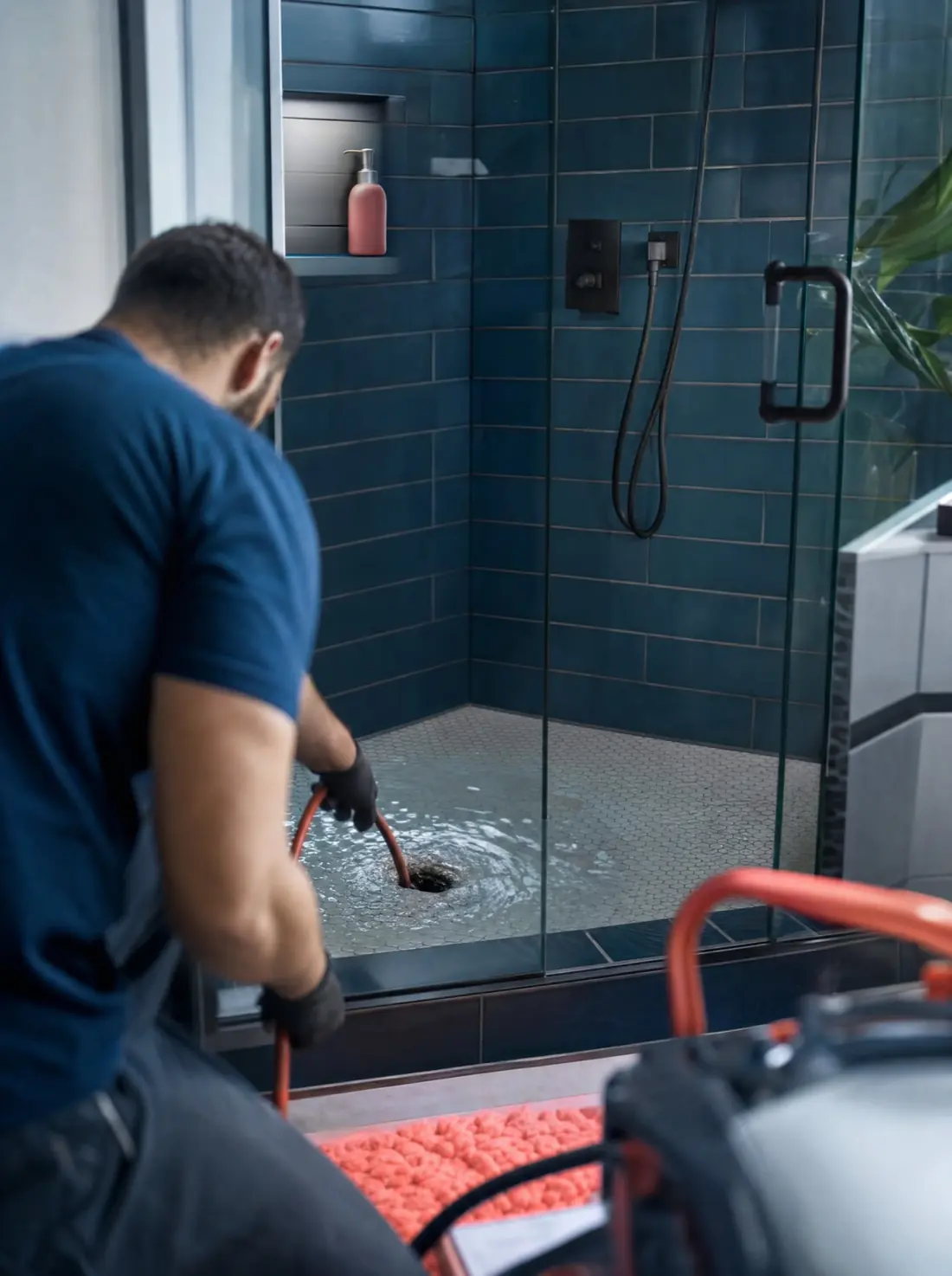
Water pooling around a clogged shower floor drain

The best five dollars you will spend

A hair catcher over the drain prevents more shower clogs than any product you can pour down one. Buy the one that sits over the strainer rather than the one that pushes into it.

Washing machine drain overflowing

A washing machine pumps out fifteen to thirty gallons in about ninety seconds, straight into a narrow standpipe. Lint, detergent residue and fabric softener build a felt-like layer inside that pipe. The line drains perfectly well between loads, then overflows during the pump-out because the machine is pushing more water than the restricted pipe can accept.

This one is urgent out of proportion to how bad the clog is. Laundry rooms tend to sit next to flooring and drywall that does not forgive standing water, and the failure happens while nobody is watching.

Warning signs
Water climbing the standpipe during the drain cycle. Damp baseboards you cannot explain. A stain on the ceiling under an upstairs laundry room.
What we do
We cable and jet the laundry line back to the stack, because lint layers come off with pressure far better than with a cutter head, then run a full drain cycle to prove it before we leave.

Please do not

  • Run one more load to see if it clears itself. That is thirty gallons betting against you.
  • Push the drain hose deeper into the standpipe to stop the splashing. That seals the pipe and causes the machine to siphon.

Blocked floor drain

Floor drains in garages, laundry rooms and utility spaces exist so that when something else fails, the room does not flood. They also almost never get used, so the trap underneath quietly fills with grit, detergent and debris until it can only take a trickle.

Because a floor drain sits at the lowest point, it is frequently the first place a main line backup appears. Clean water sitting in it points at the floor drain itself. Dirty water points at the main.

Warning signs
Water standing on the floor after a wash or a hose-down. A sewer smell from a rarely used room. Dirty water appearing in it when nothing has been running.
What we do
We clear the trap and jet the line, since sediment is exactly what pressure removes best, then camera it to confirm it runs clean all the way to the main.

Please do not

Cap or seal a floor drain to stop a smell. You are removing the only relief point in the room, and the odor is telling you the trap has dried out or the line is restricted. Pour a gallon of water down it once a month instead, which reseals the trap and keeps sediment moving.

Yard, driveway and downspout drains

Exterior drains fill from the top down with sand, mulch, oak leaves and pine straw. Jacksonville rain arrives fast and hard, so a line that is half full of silt simply cannot take the volume, and the water backs up across your driveway, your lawn, or against your foundation.

The other failure mode is structural. Corrugated pipe settles over time, and roots find the joints and lift them apart. Once a section has separated or crushed, no amount of cleaning restores it, and the only honest answer is to find the exact spot and replace that piece.

Warning signs
Water standing in a yard drain long after the rain has stopped. A soft or sunken patch in the lawn along the pipe run. Water pooling against the garage slab or the house.
What we do
We jet the exterior line end to end and flush the silt out at the discharge point, then camera and locate it. If a section has failed we mark its exact depth and position so the repair is a small dig rather than a trenched lawn.
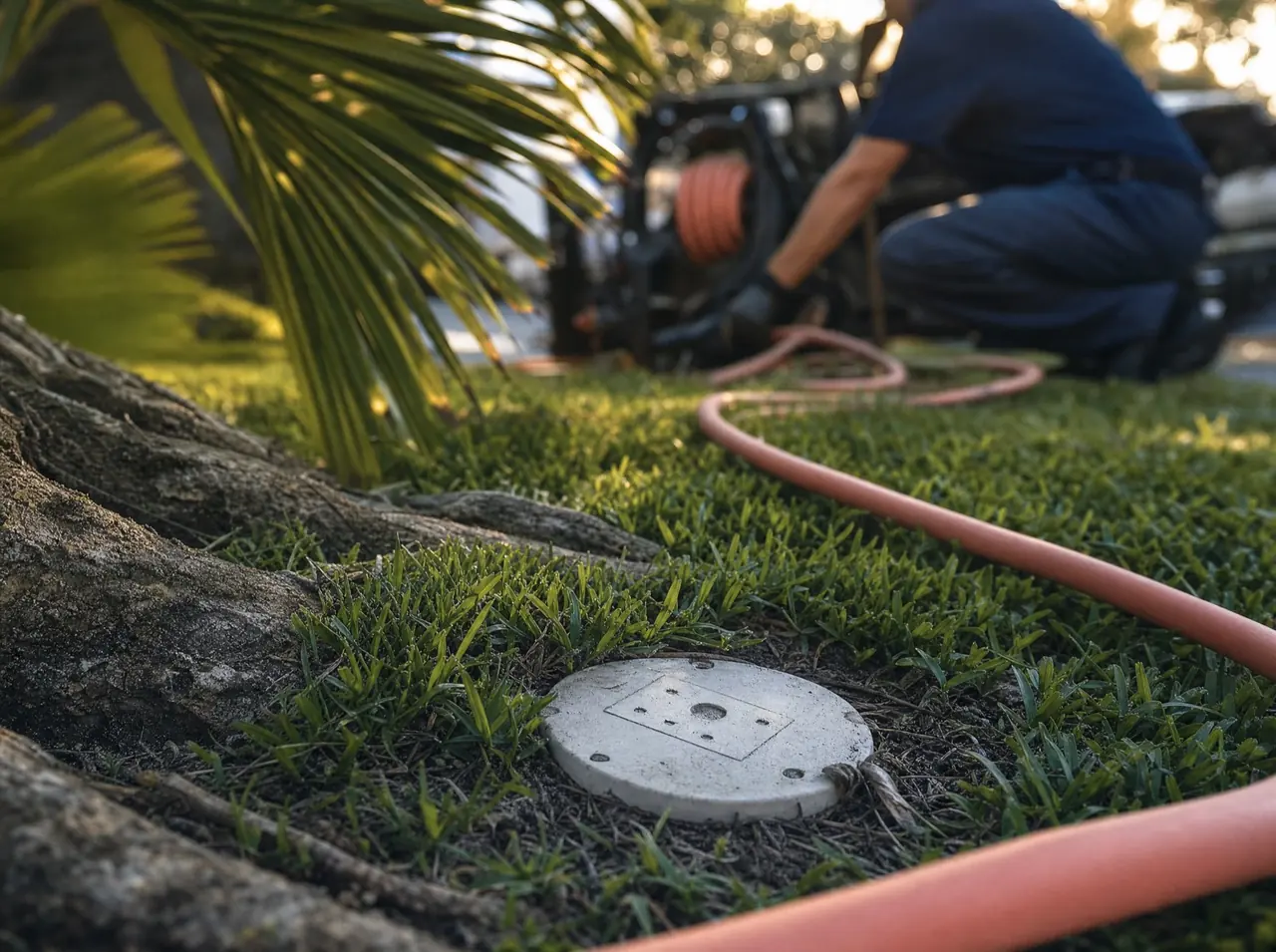
An exterior drain cleanout in a Florida lawn surrounded by palms

Please do not

Dig around blindly looking for the pipe. Irrigation lines, low-voltage lighting and utility runs share the same few inches of ground, and a locate costs a great deal less than a repair.

Main sewer line backup

The main line carries everything from the house to the street or to your septic tank. When it blocks, every drop of water you use has to come back out somewhere, and it surfaces at the lowest fixture in the building, usually a tub, a shower or a floor drain. It is not clean water.

Around here the cause is nearly always one of three things. Roots from live oaks and palms find the joints in older clay and cast iron and grow into the line. Years of grease coat the pipe until it closes. Or the line has developed a belly, a low section that holds water and collects solids instead of carrying them away.

Warning signs
Two or more unrelated fixtures slow at once. The toilet bubbles when the washer drains. Water rises in the tub when you flush. A sewer smell in the yard or a patch of grass that is greener than the rest.
What we do
We open the exterior cleanout to relieve the pressure, cable the line to restore flow, then run a camera the full length so you find out why it happened. A main line we clear without looking is a main line you call us about again.
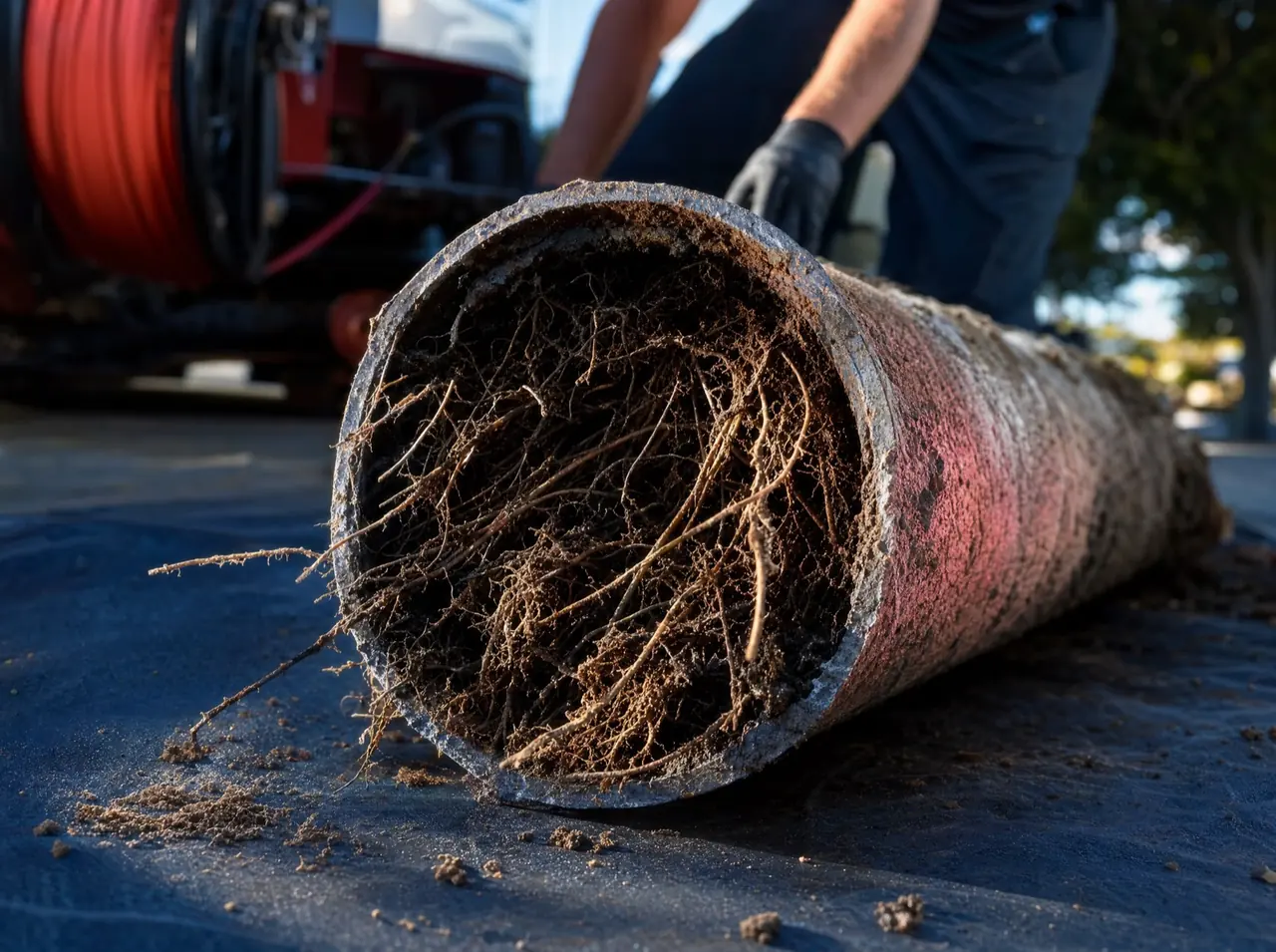
A cut section of old sewer pipe packed with tree roots

While you wait for us

  • Stop all water use, including the dishwasher and washing machine.
  • Find the exterior cleanout, a capped pipe near the house at ground level, so we can get straight to work.
  • Keep people and pets away from any water that has already surfaced.

The one thing we ask

Skip the bottle of drain opener

We are not saying that because we want the work. We would honestly rather you cleared a hair clog yourself with a stopper and a pair of gloves and never called us at all.

Chemical openers work by generating heat and eating organic matter. In a line that has genuinely stopped, the water is not moving, so the chemical sits in one place against the pipe wall doing exactly that. Older cast iron, plastic traps and rubber seals do not enjoy the experience. Meanwhile the actual blockage, which is usually grease, hair, or roots, is largely unaffected.

Then there is the practical side. If we arrive to a basin of caustic water, we have to neutralize and remove it before we can start, which costs you time on a flat-rate job. If you have already used one, please just tell us. We will not judge you, we will put on the right gloves.

It rarely reaches the problem

Most residential blockages are five to twenty five feet down the line. The chemical stops where the standing water stops.

It does not dissolve hair or roots

The two most common causes of the clogs it is marketed for.

It damages what it sits against

Cast iron, older PVC joints, chrome traps and rubber gaskets all take the heat.

It makes the fix more expensive

Standing caustic water has to be handled before any real work can begin.

Still not sure which one you have?

Tell us what it is doing

Describe the symptom on the phone and we will tell you honestly whether this is something you can handle in ten minutes or something that needs a truck.

Call now